
Morning All,
I will be away for the coming week, and while I will be collecting data from weather stations being monitored, I will be unable to upload it until I get back on the 14th.
As you can see from the table above, we are tracking at very low chill accumulation, and we are aligning 2008. Trees that still have active leaves on them are in a prechilling phase, where the loss of carbohydrates can have a significant impact on bud development in the spring and resultant off-crop yield situation arising irrespective of the post-harvest fertilisers that have been applied. Trees that have had active late growth will have immature wood that runs an increased risk of poor shoot development in the spring period (barren shoots and growth out of the crown and tips). I have visited several orchards that until this week still had some quite strong green leaf on the tree, raising some concerns as to the loss of tree carbohydrates.
One of the outcomes in 2008 (and this year is tracking along similar lines) was that I saw the impacts of low chill in several regions (Adelaide Hills with shoot failure in Pink Lady through to crop failures in almonds in the Boundary Bend area). We found crops only setting in the SW corner of some varieties being the coldest part of the tree during this season. While the season is still early, the initial accumulation of chill is low.
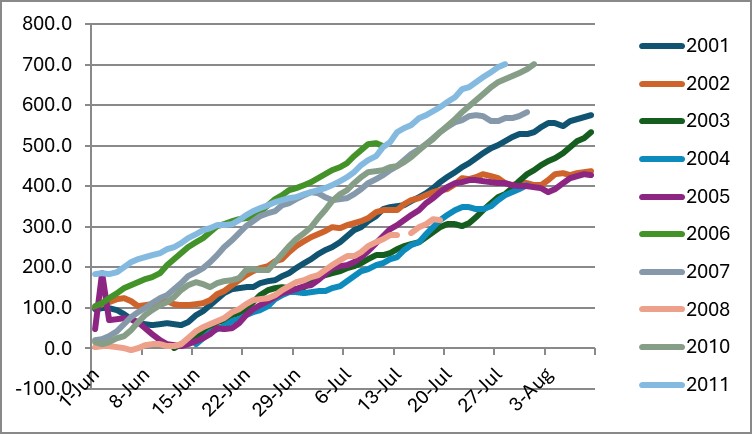
While the season has a long way to run, the numbers and forecasts from the Met Bureau suggest that, if the long-term forecast of above-average winter temperatures holds, we are potentially heading for low crop levels for the coming season without active management to enhance chill or a prolonged burst of cold weather.
Out of research work that I was fortunate enough to be undertaking initially at Tandou, and then through several journeys since in various formulations of chemistry, results have shown that in field work conducted over the past 25 years the following are reliable considerations:
- Get leaves into a weakened state no later than the middle of May.
- Apply chill polymers to enhance chill accumulation in this period.
- Chill is site specific and highly variable from season to season -monitor your own location.
- Warm spells in July – the period between the 18-23 July is particularly critical in most deciduous crops where warm periods create a false break in the tree, resulting in excessive fruit drop later during the setting phase. The application of cooling polymers in advance of warm conditions during this time can be seen to be advantageous in crop setting later.
- In pistachios, the application of cooling polymers later in the season can be seen to be significant in increasing yield in low chill regions, where late season chill accumulation is highly advantageous.
- In cross-pollinated varieties, applications of cooling polymer to slow down flowering in early varieties has been shown to help synchronize flowering to be more in line with main varieties.
Regards,
Shane Phillips | Head Chemist - Research & Development
E: shane.phillips@biocentral-labs.com
Stay connected and receive updates, resources and insights—subscribe to our newsletter today.


