
Morning All,
As the season progresses, I thought it worth refreshing the models used to calculate chill. I have been using the Richardson (or Utah model) for over 20 years and for continuity of historical data will continue with this model but will explain the chill portions next week. Under Richardson’s model hours are calculated based on temperature ranges as noted below. Next week I will discuss the chill portions model.
What we can see this early in the season is the fluctuations as the season moves from autumn to winter. The cool snap at the start of May was replaced with above average temperatures and then a warm rain event on the 16th. 2026 so far is tracking as one of the lowest chill starts in the past 10 years.
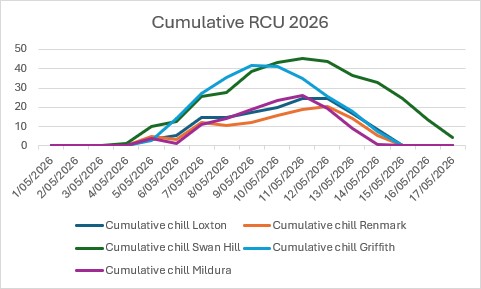

If looking over the past few years, we can see that 2026 is significantly lower in early RCU accumulation than previous years and the early gains in chill have been totally lost. It was interesting in 2017 in Swan Hill the early accumulation of chill resulted in low chill varieties that were pruned early started to produce bud burst towards the end of May as had started early flowering. At this stage it is highly unlikely to occur this season. The real concern now is regarding applications of dormancy breakers. 2026 has started with promise but warm weather has negated any of the early chill and as a result we are looking at the slowest start to chill accumulation in the past 10 years. The strategic use of chill polymers and then considerations on applications of dormancy breakers later in the season would appear to be more critical this year than previous seasons though this needs to be considered with what is going to happen temperature-wise during June and July. It is in seasons like what we are seeing unfolding where varieties can be quite staggered in bud swell and flowering.
This season we have looked at temperatures over the December period in Carmel almonds and have 2 sites that the cooling polymers were applied during December. I will be doing phenology assessments from early August in these sites to see if chill enhancement on budwood carries over into the flowering period. I am hoping it has no influence, but recent publications indicate heat loads in December play a major role in influencing non-infectious bud failure and it will be interesting to see if December heat units and winter chill maybe linked together in leaf out in the spring period.
The season is still very early, and a clearer picture will emerge as the season progresses and we see how locations are comparing to history.
Regards,
Shane Phillips | Head Chemist - Research & Development
E: shane.phillips@biocentral-labs.com
Stay connected and receive updates, resources and insights—subscribe to our newsletter today.


